What Is the Best Website Builder for a Tourism Business?
If you are starting a tour company, travel business, retreat, camp, or experience brand, you may not need a fancy website.
You need a website that works.
At first, that might mean grabbing a domain, picking a template, adding a few photos, and getting something online before your next tour leaves.
And honestly? That is fine.
The problem is when the website you built to start your tourism business becomes the website holding you back once the business begins to grow.
So, what is the best website builder for a tourism business?
The short answer: I recommend WordPress for most growing tourism businesses.
WordPress gives tour operators and travel brands more control over their content, SEO, design, booking integrations, and future functionality than most simple website builders.
That does not mean every new tour operator needs a $10,000 website on day one.
It means that even a simple WordPress website can give you a stronger foundation to build on later.
And later tends to arrive faster than you think.
What should a tourism website actually be able to do?
Before comparing website builders, there is a bigger question:
What will your website need to do as your business grows?
A tourism website is not just an online brochure.
Eventually, you may want it to:
- Show several tours, trips, or experiences
- Connect to a booking platform
- Rank for destination and activity searches
- Publish travel guides and helpful articles
- Collect email addresses
- Integrate reviews
- Add gift cards or merchandise
- Create landing pages for seasonal campaigns
- Connect with your CRM or email marketing platform
- Track conversions and advertising campaigns
- Support different locations, destinations, or tour types
- Answer common traveler questions
- Help people feel comfortable booking directly with you
This is where the website builder decision starts to matter.
Your booking software can manage inventory and reservations. Your website’s job is to create interest, build trust, answer questions, and move the traveler toward that booking.
Those are two different jobs.
The cheap website builder trap
Picture this.
You are starting your business. Cash is tight. You have three tours, some fantastic photos, and approximately 700 other things demanding your attention.
So you build a quick website through GoDaddy, Wix, Squarespace, or whatever platform gets you online fastest.
Perfectly reasonable.
The site says who you are, what you offer, and where people can book.
Then business starts moving.
Suddenly you want a separate landing page for your sunset tour because people are searching for it.
Then you want to publish articles so people can find you through Google.
Then you want a better connection with your booking system.
Then you want to run ads.
Then you need tracking.
Then you want destination pages.
Then someone tells you about schema.
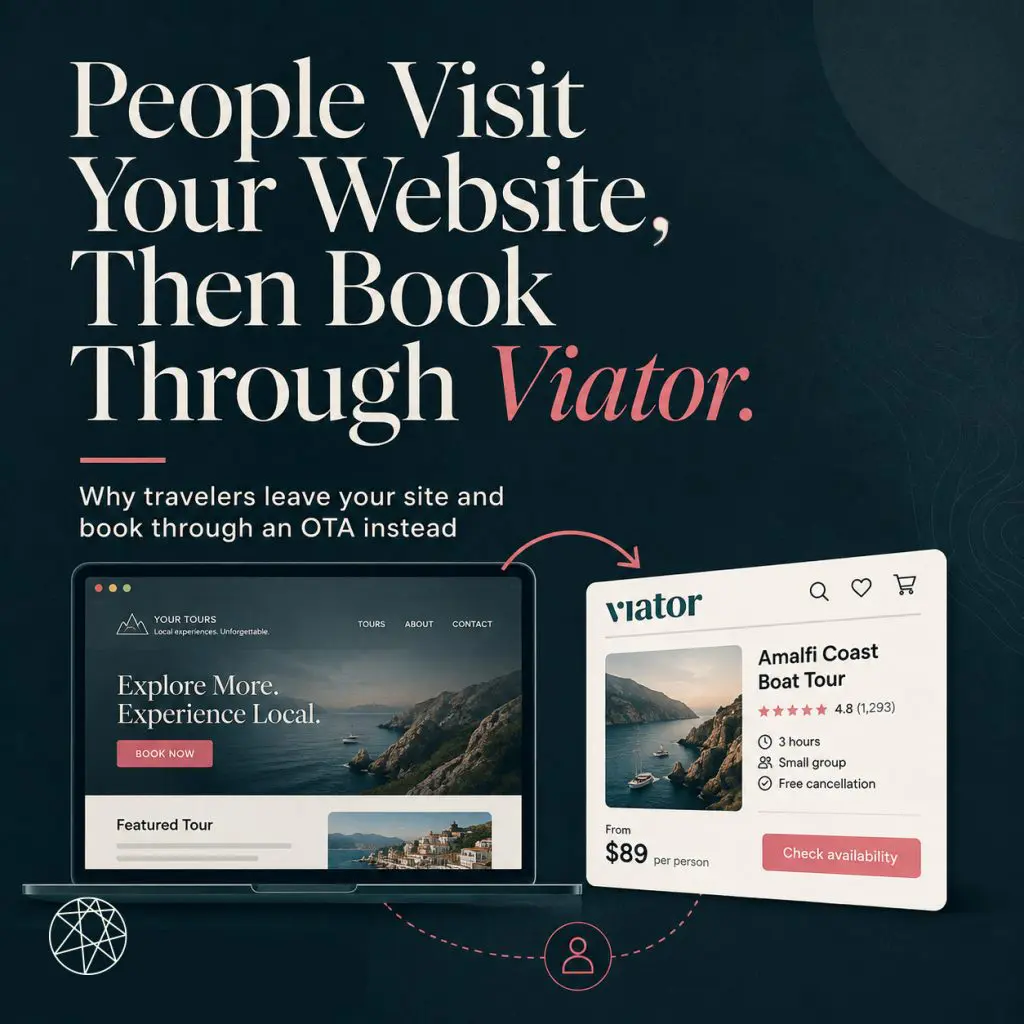
Then you want to improve your direct booking experience because travelers keep visiting your website and booking through an OTA instead.
Now that cheap little website does not feel so cheap anymore.
You are trying to run tours, answer customers, manage staff, fix tomorrow’s weather problem, and rebuild your website at the same time.
Not exactly living the dream.
Why I recommend WordPress for tour operators and tourism businesses
WordPress is not the only good platform.
It is the platform I recommend most often because of what happens after your website launches.
As of September 2026, WordPress powers about 40% of all websites measured by W3Techs and nearly 59% of websites using a known content management system.
There is a reason it has stuck around.
WordPress can start simple and become much more sophisticated without forcing you to move your entire website to a different platform.
WordPress itself is open source, and its plugin ecosystem lets businesses extend their websites with features such as ecommerce, analytics, newsletters, social integrations, forms, and other tools.
For a tourism business, that flexibility matters.
1. You can start small
Your first WordPress website does not need 40 pages, elaborate animations, or every bell and whistle known to mankind.
A small tourism business could begin with:
- Home
- About
- Tours or Experiences
- FAQs
- Contact
- Book Now
That is enough to create a professional online presence while giving you room to grow later.
You are building the foundation before you need the second floor.
2. WordPress gives you room to grow your SEO
Tourism businesses have a huge opportunity with search.
People are constantly searching things like:
- Best kayaking tours in Naples
- Things to do in Asheville with kids
- Private wine tours in Tuscany
- Women’s hiking retreats in Colorado
- Best food tours in New Orleans
Those searches can lead directly to your business.
But as your SEO strategy grows, you may need dedicated tour pages, destination pages, blog content, FAQs, internal links, structured data, optimized metadata, and other content.
WordPress gives you much more freedom to build that content structure over time.
Instead of stuffing every tour onto one giant page and crossing your fingers, you can build useful pages around what travelers are actually searching for.
3. You are not limited to one booking system
This one matters.
Your website builder and your booking system do not have to be the same platform.
Tour operators may use systems such as FareHarbor, Bókun, Checkfront, Peek Pro, Rezdy, Xola, or other reservation platforms to manage availability and bookings.
Your website can still be built separately.
In fact, tourism booking platforms themselves point out that website building and booking management are different functions. Bókun, for example, notes that generic website builders are primarily designed to build the website, while tour operators usually need separate tools for availability, reservations, channel management, and other operational tasks.
That separation can be useful.
Your booking software handles the booking.
Your WordPress website handles the selling.
It gives travelers the information, visuals, trust, and emotional buy-in they need before they click that button.
4. Your website can change when your marketing changes
Tourism businesses are seasonal.
Maybe summer means family tours.
Winter means holiday experiences.
Next year you add private trips.
Then corporate groups.
Then retreats.
Then someone on your team has the brilliant idea to launch a three-day llama meditation experience in Montana.
Fine. We can make a page for that too.
With WordPress, your marketing strategy does not have to fit inside a rigid website template.
You can build new landing pages, reorganize content, add features, test different calls-to-action, and create campaigns without starting from zero.
5. You have more control over the actual booking journey
A traveler rarely lands on your website thinking:
“Please show me your beautifully designed navigation system.”
They want to know:
Is this for me?
Is this worth the money?
Can I trust these people?
What happens if the weather is bad?
Where do we meet?
What should I bring?
Can my kid do this?
What is included?
And eventually:
Where do I book?
Your website needs to move someone through that decision without making them hunt for information.
That means your design, copy, reviews, FAQs, pricing information, photography, tour details, and booking calls-to-action all need to work together.
Your website is part of the guest experience long before the guest shows up.
If that journey feels confusing or untrustworthy, people may leave your site altogether.
So, are Wix, Squarespace, and GoDaddy bad?
No.
And I think pretending they are would be silly.
Wix currently offers travel-focused templates, booking tools, payments, scheduling, blogging, and SEO features. Tourism-specific website platforms can also be attractive because some combine website tools with reservation features.
These platforms can make sense if you:
- Need something online very quickly
- Have a tiny budget
- Offer one or two simple services
- Do not plan to invest heavily in SEO or content
- Do not need much customization
- Want to handle everything yourself
- Are still testing whether the business itself will work
Sometimes the best website is simply the one you can launch.
But I would make that decision knowing you may outgrow it.
When should a tourism business choose WordPress?
I would strongly consider WordPress if you already know you want to:
- Grow direct bookings
- Invest in SEO
- Publish useful destination or travel content
- Run paid marketing campaigns
- Integrate a third-party booking platform
- Offer several tours or experiences
- Expand into multiple destinations
- Build a recognizable travel brand
- Add more advanced website features later
- Have more control over your customer journey
That does not mean the site needs to be complicated.
Quite the opposite.
A well-built WordPress website should make running the business easier, not leave you scared to touch the backend.
But WordPress is only as good as the website built on it
This part gets conveniently left out of a lot of “WordPress is amazing!” articles.
WordPress gives you flexibility.
It does not magically give you a good website.
You can absolutely build a slow, confusing, plugin-packed nightmare on WordPress.
I have seen them.
I have fixed them.
A good WordPress website still needs:
- Reliable hosting
- Sensible plugins
- Regular updates
- Security
- Backups
- Mobile-friendly design
- Clear navigation
- Good copy
- Strong calls-to-action
- Fast-loading images
- A thoughtful booking path
The goal is not to install everything WordPress can do.
The goal is to build what your tourism business actually needs and leave room for what it may need next.
Think about the website you will need two years from now
This is the biggest thing I want tourism business owners to consider.
Do not choose a website builder based only on how easy it is to build your homepage this weekend.
Think about the business you are trying to build.
If the plan is to run a few local tours as a side project, a simple website builder may serve you perfectly well.
If you want to grow a real brand, attract travelers through search, reduce your dependence on OTAs, launch new experiences, run campaigns, build an audience, and increase direct bookings, your website needs more room to move.
That is why I recommend WordPress.
Not because every tourism website needs to be complicated.
Because your website should not become a problem the moment your business starts becoming successful.
Frequently Asked Questions
What is the best website builder for a tourism business?
For tourism businesses planning for long-term growth, WordPress is one of the strongest options because it gives businesses significant control over design, content, SEO, integrations, and future functionality. Simpler hosted builders can still work well for very small or early-stage businesses.
Is WordPress good for tour operators?
Yes. WordPress can work well for tour operators because it can support individual tour pages, destination content, blogs, reviews, FAQs, lead generation, analytics, and integrations with third-party booking platforms.
Can WordPress connect to a tour booking system?
Yes. Many tour operators use a dedicated reservation or booking platform alongside their main website. Depending on the booking provider, the website may link to the booking engine or integrate booking widgets and other functionality directly into the site.
Should my booking system and website be on the same platform?
Not necessarily. Booking software and marketing websites solve different problems. A booking system manages reservations, availability, and transactions. Your website needs to attract visitors, explain your experiences, build trust, rank in search results, and guide travelers toward booking.
Is WordPress too complicated for a small tourism business?
It does not have to be. A WordPress tourism website can begin with a small number of pages and expand over time. The quality of the setup matters more than the number of features installed.
When should I redesign my current tourism website?
A redesign may be worth considering when your website no longer reflects the quality of your experience, is difficult to update, performs poorly on mobile, cannot support your marketing strategy, or creates friction between a traveler discovering your business and making a booking.
Build for the business you are becoming
Your first website does not need to be your forever website.
But it should not create extra work six months from now either.
A simple, thoughtfully built WordPress website gives tourism businesses something valuable: room to grow.
Add the fancy stuff when you need it.
Add more tours when you sell them.
Build your SEO as the business grows.
Connect the right booking tools.
Improve the guest journey.
Your website should grow alongside the experience you are creating, instead of becoming another thing you eventually have to fix.
And if your current website already feels like something you have outgrown, that is exactly the kind of problem we solve at The Collective Design Agency.